
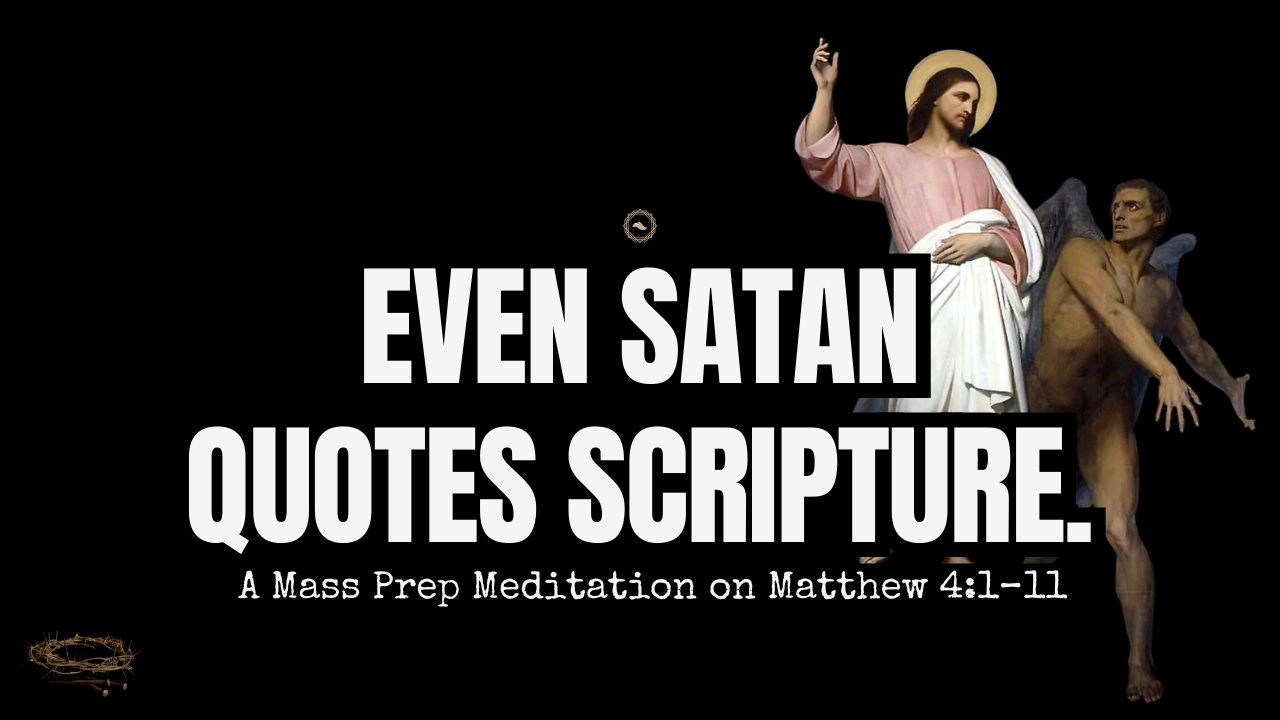
Even Satan Quotes Scripture.
A Mass Prep Meditation on Matthew 4:1–11

Lent always tempts us to think first about what we will do.
What we will give up, what we will add, or how serious we will become.
But the first line of this Sunday’s Gospel unsettles that instinct before we even have time to lace up our spiritual running shoes.
“Then Jesus was led by the Spirit into the wilderness to be tempted by the devil.” (Matthew 4:1)
He was led.
Not driven by ego. Not propelled by ambition. Not staging a forty–day spiritual showcase to prove soul intensity. The Spirit leads Him into the desert, and the text does not soften what awaits Him there. He is led “to be tempted.” The exposure is not accidental. Rather, the exposure is permitted.
For Lent, this matters more than we think.
The wilderness is not primarily a punishment for sin, nor a heroic arena for self–improvement. It is divine initiative. It echoes Hosea’s strange promise: “I will allure her into the wilderness and speak to her heart” (Hosea 2:14). The desert is not only a battleground; it is courtship ground. The Son stands where Israel once wandered, and He stands there because the Father wills intimacy that cannot be manufactured in comfort.
The spiritual fruit here is quiet and unsettling. Lent is less about proving devotion and more about consenting to be led. Where is the Spirit leading you—not to perform, but to be stripped? The wilderness exposes hunger, but it also exposes who you belong to when nothing is impressive.
After forty days and forty nights, Matthew tells us with almost painful understatement, “he was hungry.” The tempter approaches not at the beginning, but at the point of physical depletion.
“If you are the Son of God, command that these stones become loaves of bread.” (Matthew 4:3)
The attack begins with identity, not appetite. “If you are…” It is a whisper that trails behind the Father’s declaration at the Jordan: “This is my beloved Son.” The voice from heaven has barely faded when the serpent introduces doubt. Temptation often sounds like theology but feels like insecurity.
The fruit of this line is sobering. The enemy rarely begins by offering something grotesque. He begins by destabilizing what the Father has already named. Not “Turn stones into bread,” but “If you are…” An identity crisis disguised as a practical solution. How many of our sins begin there, not in open rebellion but in the anxious need to confirm who we are?
Jesus answers without agitation.
“It is written: One does not live on bread alone, but on every word that comes forth from the mouth of God.” (Matthew 4:4)
He does not argue from emotion, nor does He negotiate. He stands on what has already been revealed. The citation is from Deuteronomy, Israel’s wilderness book. Where Israel grumbled for bread, the true Son anchors Himself in the Word.
This is not mere scriptural recitation. Rather, is is fidelity. Hunger does not become His authority; revelation does. The spiritual fruit is stability. Lent does not exist to generate new spiritual fireworks. It invites us to stand on what is already true when we are tired, irritable, and unadorned. The mystic, the lover of God, is not unmoored in ecstasy; he is rooted in what God has said.
The second temptation climbs higher.
“If you are the Son of God, throw yourself down. For it is written: ‘He will command his angels concerning you…’” (Matthew 4:6)
Now the devil quotes Psalm 91. Scripture is placed on his lips without embarrassment. Evil does not always sound rebellious. Sometimes it sounds devout, careful, even protective. The distortion is subtle. A psalm about trust becomes a pretext for spectacle.
Jesus replies:
“Again it is written, You shall not put the Lord, your God, to the test.” (Matthew 4:7)
He refuses to manipulate the Father in the name of faith. He refuses to perform security. The spiritual fruit here is discernment. Not everything that sounds biblical is from God. A verse can be severed from relationship and weaponized into pressure. Scripture severed from trust becomes manipulation.
Does the word being spoken to you produce surrender, or does it demand display? Does it deepen trust, or does it dare God to prove Himself?
Lent sharpens the ear to hear the spirit beneath the verse.
The final temptation unveils its ambition without disguise.
“All these I shall give to you, if you will prostrate yourself and worship me.” (Matthew 4:9)
No more “if you are.” Now the question is allegiance. Authority without a cross. Glory without obedience. A kingdom that requires only a slight bend of the knee.
Jesus answers with clarity that feels almost liturgical.
“The Lord, your God, shall you worship and him alone shall you serve.” (Matthew 4:10)
The turning point is worship. When love is ordered, confusion loses oxygen. The devil leaves not after a dramatic struggle but after reality is named. You worship God alone. You serve Him alone. No divided altars. No quiet compromises.
The fruit of this moment is piercing. Spiritual warfare is often about ordered love. Where worship is divided, confusion lingers. Lent gently asks what small altars we have built, security, influence, approval, control, and whether we have called them necessary when they are simply familiar.
And then, almost tenderly, Matthew concludes:
“Then the devil left him, and behold, angels came and ministered to him.” (Matthew 4:11)
After the hunger. After the refusals. After the silence. The consolation is real, but it is not immediate. There is no mid–desert rescue. The obedience stands first; the comfort follows.
This too is fruit for Lent. Do not demand angels before fidelity. God’s consolation is faithful, but it is often delayed, and the delay does not mean abandonment. It means formation.
If we step back and look at the whole scene, the wilderness begins to look less like a gladiator’s arena and more like a bridal chamber stripped of decoration. The Son stands alone with His hunger, His identity, His allegiance. No applause. No crowd. No visible success. Only the Father’s word and the memory of being named beloved.
The desert is where noise dies. It is where the soul remembers who spoke over it in the water. It is where Scripture ceases to be a slogan and becomes bread. Beneath the combat runs Hosea’s promise like an underground stream: “I will allure her… and speak to her heart.”
Lent is not primarily about heroic resistance. It is about belonging when nothing impressive remains. It is about being led into places we would not choose, and discovering that even there, especially there, we are still sons, still beloved, still called to worship one alone.
The Spirit leads.
The tempter questions.
The Word anchors.
The angels wait.
And somewhere in the quiet that follows obedience, the Bridegroom speaks again.
HEY MY VIDEO REFLECTION ON THIS GOES EVEN DEEPER.
I’m getting so much out of your writings about Lent, and just want to say thank you. Deep and richly meaningful.
I wish you could see me nodding my head and hear my heart responding every time you write/talk about God pursuing us as Bridegroom and that underlying everything.