
Hungry Catholic Ghosts!
Christ, Consumerism, and the Pearl That Ends the Search

The groan is wet. A low growl—almost animal, yet unmistakably shaped by hunger.
Then comes the smell.
Smoke. Rot. Sour breath rising from a mouth that has not tasted anything in centuries.
Its feet scrape against the ground before the rest of it emerges. Thin legs. Knotted joints. Skin clinging to its frame like the last scraps of meat clinging to a carcass.
It moves slowly, but with purpose. There is something frantic and desperate beneath each step. It’s searching for something.
And then you see the belly. Swollen and round with malnutrition. It sways as it hangs, almost comically, from the thing’s skeletal frame. Above the belly, the neck narrows into a throat no wider than a needle, and atop it is a mouth that isn’t really a mouth at all. Just a puckered hole, blackened at the edges, opening and closing around that endless, useless, wet, putrid groan.
The creature then sees food.
And it lunges.
Its fingers claw at the ground. Its jaw strains wider. But the morsel will not pass through the tiny opening. In some stories, the food turns to filth before it reaches the lips. In others, it catches fire inside the mouth.
Either way, it doesn’t matter.
The ghost remains hungry.
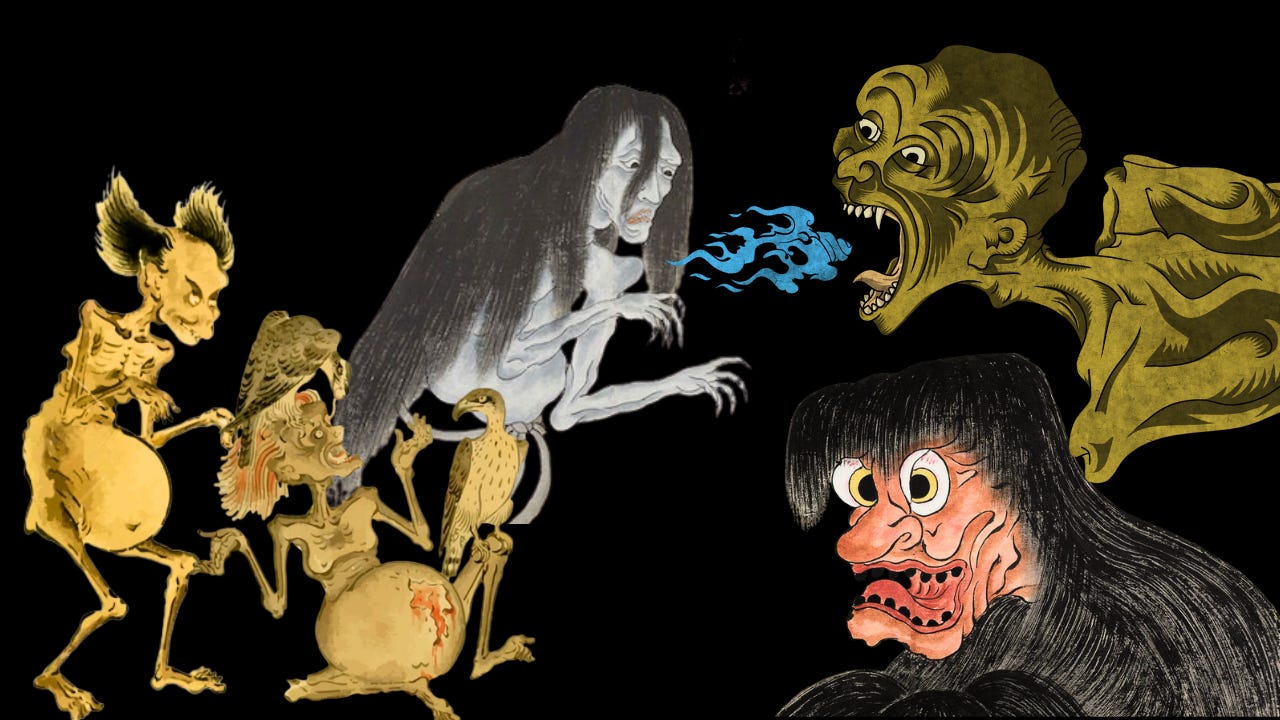
In Buddhist tradition, this is the preta: the hungry ghost, a creature cursed with an enormous appetite and almost no ability to receive what it desires.
It is grotesque, but familiar.
Because the marketplace has been trying to make hungry ghosts of us for a very long time.
The marketplace wants you to remain restless. To always be hungry and searching. It whispers in your ear that contentment is waiting for you just beyond that next purchase, or within that next version of yourself. It keeps the belly swollen but that throat of yours narrow.
And this marketplace is not only confined to the secular world. It has set up shop inside the spiritual life, too.
You’re not a good Catholic unless you meet the aesthetic.
Buy that rosary.
Purchase that book.
Attend that conference.
Subscribe to that app.You’re doing well, but you could be doing better.
You’re almost Catholic, but you would be a better one with the brown scapular.
You’re kinda holy, but you’d be holier with the right prayer routine.
You’re almost devout, you just haven’t read the right books, attended the right lectures, or watched the right YouTube videos.
You haven’t prayed the right chaplets or gone on the right retreats.
You haven’t lit the right overpriced saint-themed Etsy candles or hung the right faceless saint art icons in your prayer corner, while knocking out the latest Hallow app prayer challenge. Don’t break the streak!
You’re almost there.
Just one more purchase.
One more devotion.
One more beautiful object to prove that you belong.
The promise is always the same: you are one transaction away from becoming the person God might finally love.
This is the marketplace Christ steps into in Sunday’s Gospel (Matthew 13:44–52).
He tells us about a merchant who is searching for fine pearls. The man moves from one beautiful thing to the next, comparing, evaluating, and always looking for something better. Like the hungry ghost, he has not yet found the thing that can end his hunger.
Until he finds one pearl of great price.
And then the search ends.
For good.
It’s an easy-to-miss detail of this Gospel passage. The merchant does not place the pearl beside the others and continues his browsing. He doesn’t congratulate himself on improving his collection. He doesn’t begin searching for a matching pearl, a nicer display case, or an impressive way to show everyone what he has found.
Nope. In fact, he sells everything. Because the pearl doesn’t just complete his collection, it makes the collection absolutely unnecessary.
There is kind of a strange violence to this parable. The merchant has spent his whole life learning how to recognize value, always believing that something finer might still be waiting at the stall. Then he finds the pearl of great price, and the entire marketplace suddenly loses its power over him.
There’s nothing left to compare, browse or prove.
In the parable right before this one, Jesus tells us that the man sells everything out of joy. Not fear, obedience or guilt. But joy.
And it is this joy that separates him from the hungry ghost. The ghost groans and clutches because nothing is enough, while the man rejoices because he has found fulfillment.
Jesus Christ is not the finest product in the spiritual marketplace. He isn’t the best book, or the most powerful devotion. He isn’t the most beautiful rosary or the perfect prayer routine.
Our Lord is not one more sacred object that we can acquire and place inside the little museum of our own spiritual identity.
No, no.
He is the Treasure that makes the whole marketplace unnecessary.
And restlessness isn’t bad. It is often a restless and hungry heart that leads us into good prayer. This also doesn’t mean that rosaries, books, and prayer apps are evil. They are not. They can steady hands, teach minds and awaken hearts.
But none of those things are the Pearl.
While a rosary can teach you to look toward Christ, it cannot become Christ.
A book can tell you about God, but it cannot give you possession of Him.
And a devotion may shape your hunger, but it can never fully satisfy it.
Our problems arise when these things no longer lead us toward God, but they become evidence that we gather to convince ourselves that we are holy enough. And then, the faith becomes just another marketplace in which we remain anxious, comparing our spiritual lives against everyone else’s.
Still browsing, reaching, and comparing.
Still the hungry ghost, clawing through the dirt for another morsel that can never satisfy the ache.
The marketplace needs us hungry, but Christ does not.
He does not offer us one more thing to consume. He gives us the Treasure that ends the search.
So stop clawing through the dirt.
The Pearl has been found.
Feral Fidelity

The first proclamation of Easter morning may not have been a hymn. It may have been the raw, animal cry torn from Mary Magdalene’s throat when she looked into the tomb and found that even his body was gone.

This is so good, Tyler. And a good reminder for me. I remember how complete I felt when I first discovered Christ. Decades later, I find myself forgetting what I once knew. I needed this. I am so grateful you are writing here on Substack.
We do this with hobbies. Some dudes start hunting and golfing and have to have all the latest gear and newest techniques.